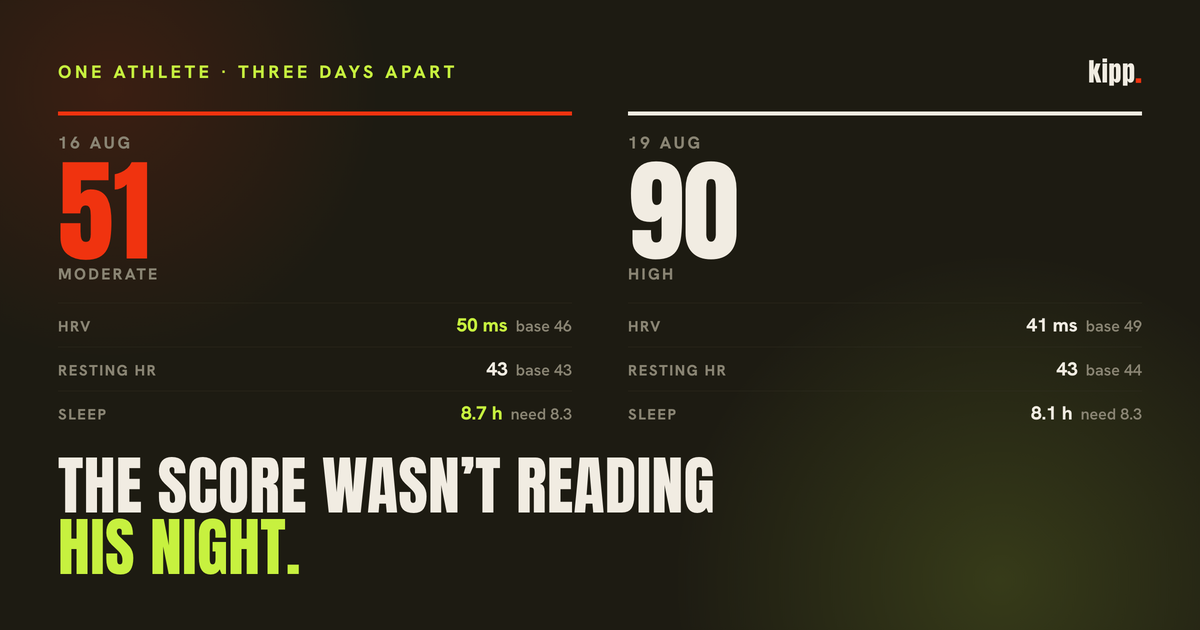
On the morning of 16 August, one athlete's watch gave him a readiness score of 51. His heart rate variability that night was 50 ms against a stored baseline of 46. His resting heart rate was exactly at baseline. He had slept 8.7 hours against a need of 8.3. Every overnight number we hold for him was at or better than his own normal, and the score sat one point above the bottom of "Moderate".
Three days later the same watch gave him 90, which is "High, ready for challenges". That morning his HRV was 41 ms against a baseline of 49, eight milliseconds below his own normal, and he had slept slightly under his need. Better numbers, worse score. Worse numbers, better score.
The short answer
A readiness score is not an independent second opinion on your training plan. Both of them already encode how hard you have been training recently, so when they disagree they are partly arguing about the same fact. Check the raw overnight numbers, because the score can move a long way without them, and treat a low reading as an instruction to cut intensity rather than to cancel.
The rest of this is where the number comes from, what it did on our own athletes' data, and the one part of our own handling of it that we had wrong.
The score is not a summary of last night
Garmin publishes the ingredients, and reading them is most of the answer.
Training Readiness is built from six inputs: sleep score from last night, recovery time, HRV status, acute load, sleep history over the previous three nights, and stress history over the previous three days. It lands on a 1 to 100 scale in five bands: Poor (1 to 24), Low (25 to 49), Moderate (50 to 74), High (75 to 94) and Prime (95 to 100).
Look at what those six things actually measure. Three of them are recovery signals. Recovery time and acute load are measures of training, not of recovery. Acute load is your recent training stress. Recovery time is a countdown, and Garmin's description of it is worth reading closely, because it is doing more than the name suggests:
"The primary basis for recovery time recommendations involves analyzing and interpreting performance data from your recorded activities. The amount of strain resulting from your workouts is interpreted based on a combination of your current fitness level and recent training history."
That is a training measure. Then, further down the same page:
"Recently, recovery time has been improved by introducing health and lifestyle tracking data to the analysis for the first time... all-day stress tracking and estimated sleep tracking data is now used to increase and decrease your recovery time recommendations, and the impact of your day-to-day activities is now also factored into the equation."
And, plainly, that "good sleep, low stress and light daily activity levels can all shorten recovery time recommendations."
Hold on to that last one. Your daily activity, not your training, moves recovery time, and recovery time moves your readiness score.
So the score is not a verdict on your night. It is a blend of your night and your recent training, and your training plan is a statement about your recent training too. That is the whole reason these two so often seem to argue. They are not two witnesses who happened to see different things. They share a source.
There is a second thing in Garmin's own manual worth quoting, because a great deal of published advice assumes the opposite:
"The score is continuously calculated and updated throughout the day."
Training Readiness is not a morning verdict that stands until bedtime. We had this wrong in our own notes, which described it as the morning score in contrast to Body Battery's within-day one, and the manual is unambiguous. Both are moving numbers. The time you happen to glance at your wrist is an input to what you see.
What it looked like on our own data
We store a recovery score alongside HRV, resting heart rate and sleep for every athlete whose device reports one. That gave us a way to ask a question the vendor documentation does not answer: over real days, what does the summary score actually move with?
Two caveats first, and they are large. This is a small roster, the numbers below come from two athletes, and the longest series is ten days. Nothing here is a population finding. Second, our stored score field is filled from whichever source an athlete has, so it can hold a Garmin score for one athlete and a number read off a pasted screenshot for another. For the correlations below we used only athletes with a connected Garmin.
Start with how rare the number is. Across 273 days carrying at least one measured recovery field, only 35 of them, 12.8%, carried a summary score at all. Fourteen athletes have produced a sleep duration at some point, eleven a resting heart rate, ten an HRV reading, and only eight have ever produced a score. The single number people are most likely to make a decision on is the one we hold least often.
Now the part that surprised us. For the athlete in the opening, over his ten scored days with activity recorded:
| Compared against | Correlation with the score |
|---|---|
| Same-day active calories | r = -0.92 |
| Same-day steps | r = -0.78 |
| Sleep hours | r = +0.61 |
| HRV | r = -0.28 |
| HRV relative to his own baseline | r = -0.37 |
| Previous day's active calories | r = +0.28 |
The score tracked how much he had already moved that day far more tightly than it tracked anything measured while he slept, and its relationship with HRV came out slightly backwards.
On a second Garmin athlete with five scored days carrying activity, same-day active calories came out at r = -0.82, so the load relationship held. His HRV correlation was +0.67, in the opposite direction to the first athlete's. A third athlete had four usable days and showed nothing at all, r = -0.05.
Take that for exactly what it is: two athletes, five and ten days, one consistent pattern and one inconsistent one. It is not proof of anything about Garmin's algorithm.
It is, though, the behaviour the documentation predicts. Garmin says day-to-day activity levels feed recovery time, and recovery time feeds Training Readiness. A score wired that way, recalculated continuously and sampled at whatever hour a sync happens to run, should fall as you spend your day, and in these two athletes it did, hard. What we have not tested directly is the sampling half of it: whether the same athlete's score read at 7am and again at 7pm differs in the way this implies. That needs a morning-versus-evening comparison on many more athletes, and we have not run one.
Which brings the opening pair into focus. On the day he scored 51 he walked 25,902 steps and burned 1,321 active calories, the biggest day in the window. On the day he scored 90 he did 10,848 steps and 442. The 51 was not a report on his recovery. It was substantially a report on his afternoon.
Body Battery is answering a different question again
Body Battery is a separate metric and it is worth keeping the two apart, because in conversation people use "Body Battery" to mean any readiness-flavoured number their Garmin shows them.
It runs 5 to 100, in four bands: 5 to 25 very low reserve, 26 to 50 low, 51 to 75 medium, 76 to 100 high. It charges with rest and drains with activity and stress, and Garmin's manuals note that periods of rest appear as blue bars on the graph. The algorithm comes from Firstbeat Analytics, which Garmin acquired in 2020, and blends HRV, sleep and activity.
An energy reserve that drains as you use it is a genuinely useful thing to have. But it is not a recovery verdict, and the difference matters most at exactly the moment people consult it. Body Battery at 30 at 6pm is a description of your day. Body Battery at 30 at 7am is a description of your night. The same number carries completely different information depending on when you read it, and only the second one is telling you something about whether to train.
Here is our own version of that mistake. Our Garmin integration reads Training Readiness and stores it as the athlete's recovery score. When Training Readiness is not available, it falls back to Body Battery's most recent value and stores that in the same field. Two different constructs, one column, no marker to say which one you are looking at, and a coach downstream reading all of it as a morning recovery verdict. The daily trend backfill does not carry the score at all, so this only ever affected the live read, and it is a small thing. It is also precisely the error the rest of this article is about, committed by us.
Does obeying the number actually work better?
This is the question underneath "should I do the intervals", and it has been studied properly, though not extensively.
The best current summary is a 2021 systematic review and meta-analysis by Manresa-Rocamora and colleagues, covering 8 studies and 199 participants (106 doing HRV-guided training, 93 following predefined plans, mean age 31.8). Comparing guided against predefined training, it found:
- Endurance performance: SMD+ = 0.20, 95% CI −0.09 to 0.48, p = 0.18. A small effect favouring the guided approach, not statistically significant.
- VO2max: SMD+ = 0.13, 95% CI −0.12 to 0.39, p = 0.30. Trivial, not significant.
The authors are direct about the limits: "a limited number of overall investigations, in addition to inconsistent methodological approaches, limit our ability to perform sufficient subgroup analyses to make strong conclusions."
So the honest answer is that letting a recovery signal steer your training has not been shown to make you faster than following a sensible plan. Anyone telling you otherwise is over-reading 199 people.
What the literature does report consistently is the second half: the guided groups got those equivalent results while doing fewer moderate and high intensity sessions. That is a real result and it changes what autoregulation is for. It is not a performance edge. It is the same outcome for less hard work, which is an argument about injury risk, sustainability and how much of your week you spend wrecked, and those are better reasons than a marginal gain that the data does not support.
The part we got wrong
Our coach has a rule for exactly this conflict, and until we went looking for this article we had not noticed it only handles one direction.
The rule tells it that a recovery score is useful as a summary but must be reconciled with the raw inputs, and then gives an example: if the score says green but HRV has cratered and sleep was five hours, trust the raw signals and say so.
Every word of that is right, and the example only covers the case where the score is too optimistic. There is no example for the reverse, which is the one this article is about, and which our data suggests is common: a score in the Low band on a morning when HRV, resting heart rate and sleep are all fine. We have a documented lesson of our own that an example in a prompt outvotes the rule above it, and we walked into it here. Our coach was better equipped to talk an athlete out of a falsely good score than out of a falsely bad one.
That is one sentence to fix and we have written it down. Worth saying plainly that we found it by measuring our own field rather than by reading our own code.
What we do with the conflict
The rules underneath our coaching for this specific situation, which are the part worth stealing whether or not you ever use the app:
- The lever is volume and intensity, not all or nothing. A low readiness reading rarely means skip. It means dial the day back. Garmin says as much about its own gauge: "If your recovery gauge is not green, you can still perform an easier workout while maximizing your recovery."
- Full rest is for signals that stack. Reserve it for HRV well down and resting heart rate up and poor sleep and high soreness together. One of the four is noise.
- Cut the quality work before the easy volume. On an endurance day that means shortening the intervals or dropping a rep of them, keeping the easy running genuinely easy, and protecting the week's key session. Six by 800 becomes four by 800 at the same effort, not four by 800 run harder to compensate.
- On a lifting day, protect the main lift and trim the accessories. Cut top-set intensity by 5 to 10% and drop a back-off set rather than deleting the session.
- How you feel is data, not a tiebreak. An athlete who feels wrecked at a green score is reporting something the wrist did not see, and it is frequently the deciding input.
- What you did beats what the plan says. If you already did the session, moved it, or swapped it for something else, that is the truth of your week. The plan is a hypothesis written weeks ago.
What to do tomorrow morning
- Read the score once, in the morning, before you have done anything. A continuously recalculated number consulted at 4pm is contaminated by your day. If you are going to let it influence a decision, sample it at the same hour every day.
- Open the raw numbers underneath it. HRV against your own baseline, resting heart rate against your own baseline, and hours slept against your own need. Three numbers, ten seconds. If they are fine and the score is low, you have your answer about which to believe.
- Ask what the score is punishing you for. Recovery time and acute load are in there. If yesterday was hard, a low score today is the watch agreeing with your plan about your training, not disagreeing with it.
- Change the session, do not delete it. Cancelling is the response to four bad signals stacking, not to one number in the Low band.
- Do not let the score set the target either. A Prime reading is permission to take the session you planned, not an instruction to add to it.
Two numbers that disagree feel like a contradiction that has to be resolved before you can act. Usually it is not one. It is two partial views of the same week, sampled at different moments, and the useful question is not which to obey but which fact each of them is reporting.
Kipp reads HRV, resting heart rate and sleep against your own baselines rather than a summary score, and adjusts the session you already had rather than issuing a verdict. When the wearable has not reported, it says so and asks how you slept instead of inventing a number.
Sources
- Training Readiness definition, the six input factors, the five score bands, and the statement that the score "is continuously calculated and updated throughout the day", from Garmin's own owner's manuals. Forerunner 955 Owner's Manual, Garmin Technology: Training Readiness
- Body Battery ranges of 5 to 100 and the four reserve bands, charging with sleep and draining with strenuous activity and stress, and rest periods shown as blue bars. vívoactive 5 Owner's Manual, Garmin Technology: Body Battery
- Recovery Time: the EPOC-based training load basis, the acute to chronic load ratio, the addition of stress and sleep tracking, the statement that "the impact of your day-to-day activities is now also factored into the equation", and the advice that a non-green gauge still permits an easier workout. Garmin Technology: Recovery Time
- Firstbeat Analytics as the source of the Body Battery algorithm, and its blend of HRV, sleep and activity data. Garmin Body Battery FAQ
- Manresa-Rocamora A, Sarabia JM, Javaloyes A, Flatt AA, Moya-Ramón M. Heart Rate Variability-Guided Training for Enhancing Cardiac-Vagal Modulation, Aerobic Fitness, and Endurance Performance: A Methodological Systematic Review with Meta-Analysis. International Journal of Environmental Research and Public Health 2021;18(19):10299. 8 studies, 199 participants. doi:10.3390/ijerph181910299
- The 273 recovery days, the 12.8% score coverage, the per-athlete correlations and the 16 and 19 August readings are from our own roster, measured for this article. Two athletes, ten and five scored days. Small sample, single roster, and we are not claiming it generalises.