Your half marathon is twelve weeks away. You can already run 10 km comfortably, you lift regularly, and you want a plan that leaves room for both.
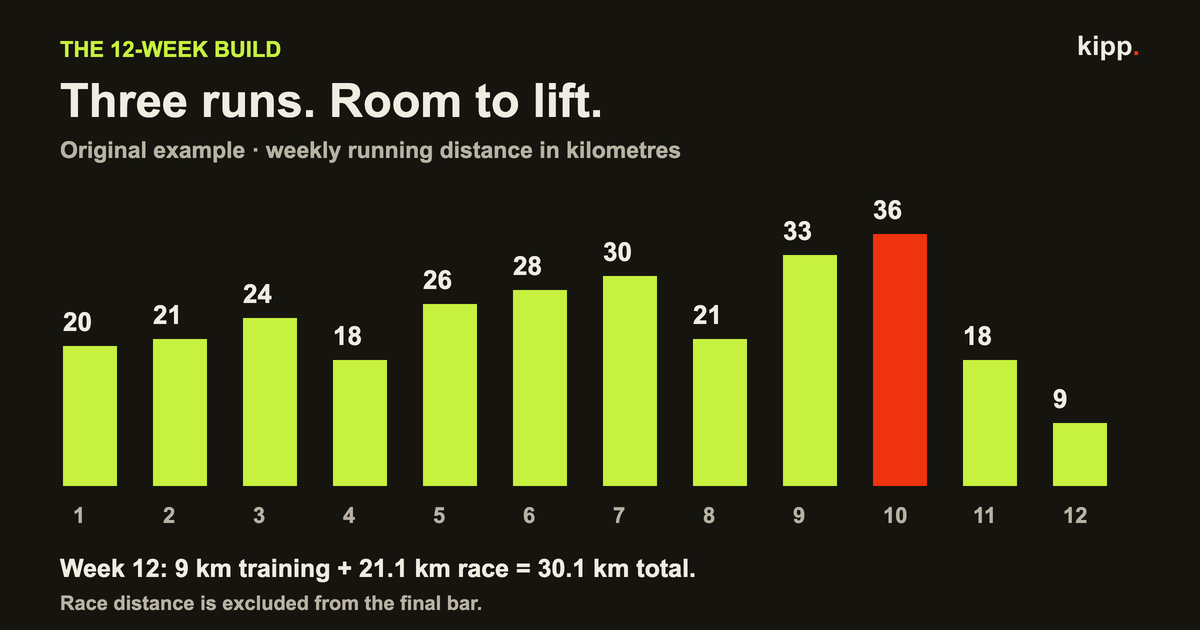
The schedule below gives you three runs and two gym sessions in a normal training week. It starts at 20 km, reaches a 36 km peak, and includes a four-day version for weeks when five separate training days will not fit.
The short answer
Build the week around an easy run, a controlled quality run and a long run. Keep two familiar strength sessions in the main block, with the harder leg work placed away from the run you most want to protect. The 12-week table below is an original coaching example for someone already running and lifting; its exact progression has not been tested in a study.
Before you start
Week one contains 5 km, 5 km and 10 km runs. Those distances should resemble a week you can already complete comfortably, alongside your current gym work. A single all-out 10 km effort is a different starting point. If this would be a substantial increase, spend longer building a repeatable base before using the table.
The plan is written for a runner who wants the half marathon to take priority during this block. It does not promise a squat personal best at the same time. It is also not a return-from-injury programme. Pain that changes your stride or persists needs assessment rather than another calendar adjustment.
The distances, session examples and starting assumptions here are coaching choices. Use them as a template to adapt to your history, available time and recovery, not as a pass-or-fail test.
Your usual week
| Day | Session | What it is for |
|---|---|---|
| Monday | Rest | A day clear of planned training |
| Tuesday | Easy run | Comfortable running at a conversational effort |
| Wednesday | Quality run, or easy when indicated | A small amount of controlled faster running |
| Thursday | Lift A: lower body | Familiar leg work, without grinding repetitions |
| Friday | Rest | A clear day before the long run |
| Saturday | Long run | Easy effort as the distance grows |
| Sunday | Lift B: upper body | A gym session with little additional leg work |
This adapts the original carousel's two generic “LIFT” slots into separate lower- and upper-body sessions. Thursday's legs are separated from Saturday's long run by Friday, but the weekday labels do not establish an exact recovery interval. Thursday evening to Saturday morning is less than 48 hours.
A review by Doma and colleagues describes how residual fatigue after resistance training can impair subsequent endurance work. It supports paying attention to session order and recovery. It does not validate this calendar or establish a universal 48-hour clearance. If Thursday's lift repeatedly spoils Saturday's run, change the lift's dose or its position.
The 12-week running plan
All distances are kilometres. The quality-column distance is the whole run, including easy warm-up, recoveries and cool-down. The faster minutes fit inside it; they are not extra distance to add afterward.
| Week | Easy run | Quality-day total | Long run / race | Weekly total |
|---|---|---|---|---|
| 1 | 5 km | 5 km, all easy | 10 km | 20 km |
| 2 | 5 km | 5 km, all easy | 11 km | 21 km |
| 3 | 6 km | 5 km, with 2 × 4 min controlled | 13 km | 24 km |
| 4 | 5 km | 4 km, all easy | 9 km | 18 km |
| 5 | 6 km | 6 km, with 3 × 4 min controlled | 14 km | 26 km |
| 6 | 6 km | 6 km, with 2 × 6 min controlled | 16 km | 28 km |
| 7 | 7 km | 6 km, with 3 × 5 min controlled | 17 km | 30 km |
| 8 | 5 km | 5 km, all easy | 11 km | 21 km |
| 9 | 7 km | 7 km, with 2 × 8 min controlled | 19 km | 33 km |
| 10 | 8 km | 8 km, with 3 × 6 min controlled | 20 km | 36 km |
| 11 | 5 km | 5 km, with 2 × 4 min controlled | 8 km | 18 km |
| 12 | 5 km | 4 km, with 3 × 1 min controlled | 21.1 km race | 9 km training + race = 30.1 km |
“Controlled” means an effort you can repeat without sprinting or chasing a maximum. A workable example is your realistic half-marathon effort, with two minutes of easy jogging between repetitions. Start and finish with easy running. If your pace leaves too little room inside the listed distance for that, shorten or omit the faster section rather than squeezing out the warm-up. These sessions are examples, not targets validated by the research below.
Weeks four and eight reduce distance. The following week returns to the building phase; the jump from a reduced week should not be mistaken for a requirement to increase regardless of how you feel. Repeat or reduce a week when needed. If you run out of weeks before race day, reassess the goal rather than compressing the remaining mileage.
At the peak, the 20 km long run accounts for about 56% of the 36 km week. That is a substantial share concentrated in one outing. This three-run template will not suit everyone, and the 20 km run is not compulsory for finishing a half marathon. Shorten it if the duration or fatigue is disproportionate to the rest of your training.
Why stop at these distances?
The table expands the running distances from our half-marathon carousel. Its progression is an editorial example, not a programme tested on our users.
In an observational study including 556 half-marathon runners, Fokkema and colleagues found that more than 32 km per week was associated with faster finishes than 20–32 km. That does not show that moving any particular runner above 32 km will make them faster. The study does not establish a minimum weekly distance or validate our 36 km peak.
What to do in the gym
Keep exercises you already know. The following sessions come from our four-day training example; the sets, repetitions and exercise choices are a starting template, not a study-tested prescription.

| Lift A: lower body | Working sets × reps | Lift B: upper body | Working sets × reps |
|---|---|---|---|
| Squat | 3 × 5 | Bench press | 3 × 6 |
| Romanian deadlift | 2 × 8 | Row | 3 × 8 |
| Split squat | 2 × 8 per leg | Overhead press | 2 × 8 |
| Calf raise | 2 × 12 | Lat pulldown | 2 × 8 |
Warm up separately. As an example effort limit, choose weights that leave about two good repetitions available at the end of a set, and rest two to three minutes between working sets. Familiar alternatives are fine. Introducing several unfamiliar lifts while also increasing your long run makes the week's response harder to judge.
A 2024 meta-analysis of 31 studies involving 652 runners found that high-load strength training can improve running economy, with moderate-to-low certainty for the main outcomes. That supports including strength work. It does not prove these two sessions will preserve every lift or improve your half-marathon time.
If leg fatigue starts affecting your runs, one example adjustment is to reduce the lower-body session from nine working sets to six: two squat sets, one Romanian deadlift set, one split-squat set and two calf-raise sets. Keep recording the weight and repetitions, and reassess the next run. Reduce the load too if the repetitions stop being controlled.
Only four training days? Combine the easy run and upper body
Use Tuesday for lower-body strength, Wednesday for the easy run plus upper-body strength, Friday for the quality run, and Sunday for the long run. Monday, Thursday and Saturday stay free. The running distances remain those of your current week in the table.

You can split Wednesday's sessions across the day if that fits your routine. Budget time for both, including travel and changing. If the combined day is repeatedly too long, reduce the plan's demands rather than relying on a slot you rarely have.
This arrangement is for the main training block. It does not override the reduced gym work and race-day adjustments below.
The last two weeks: make room to arrive fresh
Week eleven reduces running from the 36 km peak to 18 km, a 50% cut. Week twelve contains 9 km before the race; its 30.1 km total includes the race itself. Comparing that total directly with week eleven would disguise the reduction in pre-race training.
A meta-analysis of 14 studies involving 174 endurance athletes supports tapering by reducing volume while retaining some intensity and frequency. The studies covered different events and training backgrounds. They do not validate our exact two-week finish or gym schedule.
For this example, use just one reduced, familiar gym session in week eleven and omit demanding lifting in race week. If you retain faster running, keep it brief and controlled as shown in the table. These are coaching choices intended to reduce fatigue, not an instruction to chase fitness tests before the race.
The main table assumes a Saturday race. For a Sunday race, Sunday replaces Saturday's long-run slot, Saturday becomes rest, and there is no Sunday upper-body session. Leave enough recovery after the final run for your usual response rather than filling the spare day.
When the week stops going to plan
The following are practical defaults for this template, not experimentally validated rules.
| What happened | A reasonable adjustment |
|---|---|
| You missed leg day | If making it up puts it immediately before the important run, skip the catch-up and resume next week. |
| Your legs still feel heavy during the easy warm-up | Make the planned quality run easy or shorter, then review the leg session that preceded it. |
| You missed the long run | Do not add its kilometres to the next run. Reassess the remaining week and whether to repeat it. |
| Several sessions were missed through illness | Reassess your return and race goal. Do not cram the missing sessions into the next week. |
| The same session keeps getting dropped | Change the weekly arrangement or total demand. The calendar is giving you useful feedback. |
What to watch on your wearable, and what to log yourself
Record the running you actually completed and how it felt. For lifting, keep the exercise, weight and repetitions. A watch-recorded “strength training” session may tell the receiving app that you trained without supplying the sets needed to assess lift progress.
We traced that distinction in our Apple Watch strength-workout article. Our connector activity model and separately logged exercise sets are different records. A synced duration or calorie total cannot fill in a missing squat load. That is a limit of the receiving data path we inspected, not a claim about every lifting app.
Use recovery readings as additional context alongside the sessions and your own report. If a score conflicts with the plan, first check what it measures and whether the data is current. Our guide to Body Battery and planned intervals covers that distinction. One score cannot establish that a difficult run is appropriate today.
Kipp can help you discuss changes to this kind of week using your logged training and available recovery data. For example: “I missed Thursday's leg session, Saturday is my long run, and I can only train Friday evening. What should I change?” That is an illustrative use case, not a recorded athlete outcome. Tell the coach your real constraints and agree the adjustment; a static table cannot account for those changes by itself.
Questions before you use the plan
Can I keep lifting throughout half-marathon training?
This example keeps two gym sessions in the main block and reduces them near the race. It assumes you already lift. Adjust the dose when it affects running; the plan cannot promise strength maintenance or a finish time.
Is this a beginner half-marathon plan?
It starts with 20 km in a week and a 10 km long run, alongside lifting. It is for someone who already tolerates that combination. If week one is a stretch, build a repeatable base first or choose a plan matched to your starting point.
Can I fit it into four days?
Yes, by combining the easy run and upper-body session on Wednesday in the alternative schedule. You still need time for five sessions. Keep the long run and quality run separate, and apply the taper adjustments near the race.
Should I catch up a missed leg session?
Not automatically. If the only free slot is immediately before the long run you want to prioritise, this template's default is to skip the catch-up lift. Repeated clashes mean the schedule needs changing.
Sources
- Fokkema et al. (2020): Training for a (half-)marathon. Observational analysis, including 556 half-marathon runners. Supports the association described above, not the table's progression.
- Doma, Deakin and Bentley (2017): Implications of impaired endurance performance following single bouts of resistance training. Narrative review; cited for residual fatigue, not a fixed recovery window. No pooled participant count is asserted here.
- Llanos-Lagos et al. (2024): Strength training and running economy. Meta-analysis, 31 studies and 652 runners; moderate-to-low certainty for the main outcomes.
- Wang et al. (2023): Effects of tapering on performance in endurance athletes. Meta-analysis, 14 studies and 174 athletes. Informs the taper discussion, not the exact schedule.