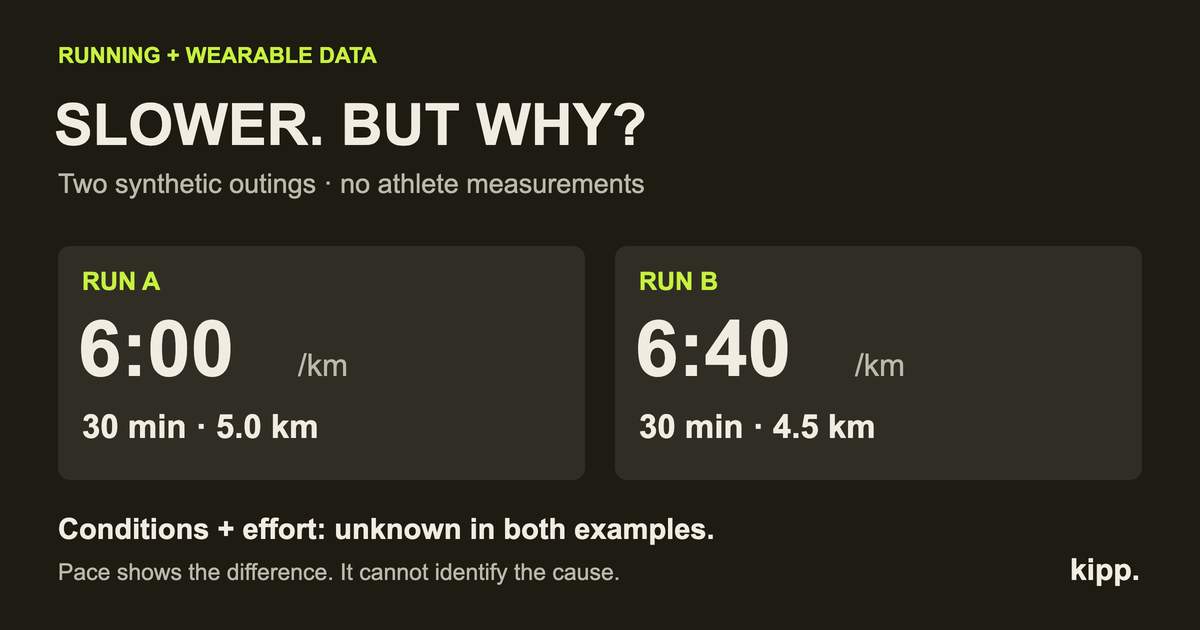
Last month, your easy runs often showed 6:00/km. This week, the watch keeps showing 6:40/km, and keeping the old pace makes the run feel much less easy.
That difference is worth investigating. It cannot tell you its own cause. Before changing the training plan, establish whether you are comparing similar routes, conditions, timing and effort.
The short answer
Keep the easy run at an appropriate easy effort while you check the comparison. A slower pace can reflect changed conditions, accumulated workload, a different calculation, or reduced fitness. The pace figure alone cannot distinguish them.
This is a troubleshooting guide for a healthy runner who already trains and uses wearable records. The examples and comparison workflow are original illustrations, not a diagnostic test or medical advice.
First, check that the two pace numbers mean the same thing
A run can have a moving time and an elapsed time. Stops affect those clocks differently. If you compare a moving-time pace from one app with an elapsed-time pace from another, you can manufacture an apparent slowdown without changing the running.
We traced that difference in our Strava moving-time article. Start with the same app, activity type and pace calculation before interpreting a trend. Check distance and the route trace too; an unusual trace deserves a data check before a training explanation.
What the pace arithmetic does tell you
| Synthetic run | Duration | Distance | Calculated pace |
|---|---|---|---|
| A | 30 minutes | 5.0 km | 6:00/km |
| B | 30 minutes | 4.5 km | 6:40/km |
Both examples use the same duration definition and exact illustrative distances. Thirty divided by 4.5 is 6.6667 minutes per kilometre, or 6 minutes 40 seconds. Run B covers less distance in the same time.
Nothing in those three numbers establishes the temperature, wind, hills, stops, heart rate, soreness or intended effort. They describe performance on those outings, not the reason for the difference. These are synthetic cases, not results from Kipp athletes.
Compare the surroundings before you compare yourself
| Check | What to compare | A useful next step |
|---|---|---|
| Route | Hills, surface and direction | Revisit a familiar route rather than comparing road pace with trails |
| Conditions | Heat, humidity and wind | Note the conditions and keep the effort appropriate |
| Clock and distance | Moving versus elapsed time, unusual route trace | Use matching fields and check the original activity |
| Recent training | Leg sessions, intervals and long outings before the run | Compare runs with similar lead-in days |
| Effort | Breathing, perceived effort and available heart-rate record | Ask whether the run was actually easy |
| Recovery context | Sleep, food, stress and how you feel | Look for repeated patterns without inventing a missing measurement |
The consensus recommendations on training in the heat explain that heat can reduce endurance work rate and that dehydration can add cardiovascular strain. That supports considering conditions, not applying a fixed pace penalty to every warm run. It is consensus guidance, not a trial establishing your personal correction factor.
Keep the effort in view
The CDC's talk-test guidance uses speech as a rough indicator of relative exercise intensity: talking is easier at moderate intensity than at vigorous intensity. That general cue is not a lab threshold or a way to calculate your personal Zone 2.
For an easy run, use your familiar comfortable breathing and effort alongside the available data. If holding last month's pace makes today's easy outing demanding, slow down rather than upgrading the session to defend a number. That is this guide's coaching choice, not a diagnosis of why the run feels different.
Heart rate adds context but does not finish the investigation. A different reading can accompany different conditions, effort or a recording issue. Look at the trace and whether it fits how the run felt before treating the average as a precise fitness comparison. No universal pace-to-heart-rate conversion is prescribed here.
For lifters, compare the day before
An easy run after a familiar rest day is a different scheduling situation from a run after demanding leg work. Look at the exercises, sets and effort you actually completed, rather than just whether both weeks contain a gym session.
If the pattern repeatedly follows the same lower-body workout, try moving or reducing that workout and observe the next comparable run. That is a practical scheduling experiment, not proof that lifting caused the whole slowdown. Our same-day running and lifting guide covers the order question.
A simple comparison you can repeat
Choose a familiar easy route and your usual easy duration. On future outings, note the conditions, your effort and the preceding training rather than repeatedly turning it into a time trial. There is no need to add an extra test day just to create a cleaner chart.
Compare several reasonably similar outings. If the difference persists under similar conditions, or several parts of training feel harder, review the overall load and recovery before adding intensity. This checklist sets no number of runs that proves fitness has changed.
Stop and seek appropriate help for concerning symptoms such as chest pain, fainting or severe unexpected breathlessness. Persistent unexplained fatigue or reduced exercise tolerance also deserves assessment. A recovery score, pace trend or calendar cannot clear you medically.
Sources
- Racinais et al. (2015): Consensus recommendations on training and competing in the heat. Supports considering environmental strain, not a personal pace adjustment formula.
- CDC: How to measure physical activity intensity. Public-health explanation of relative intensity and the talk test, not an athlete-specific zone prescription.
- The two runs and comparison checklist are original examples; no measured fitness decline or cause is claimed.
Kipp can discuss your recorded runs alongside recent training and available recovery information. Mention conditions or symptoms that the record does not contain, such as a hot route or unusually heavy legs. Missing weather, effort or heart-rate data should stay unknown rather than become an explanation invented to fit the pace.