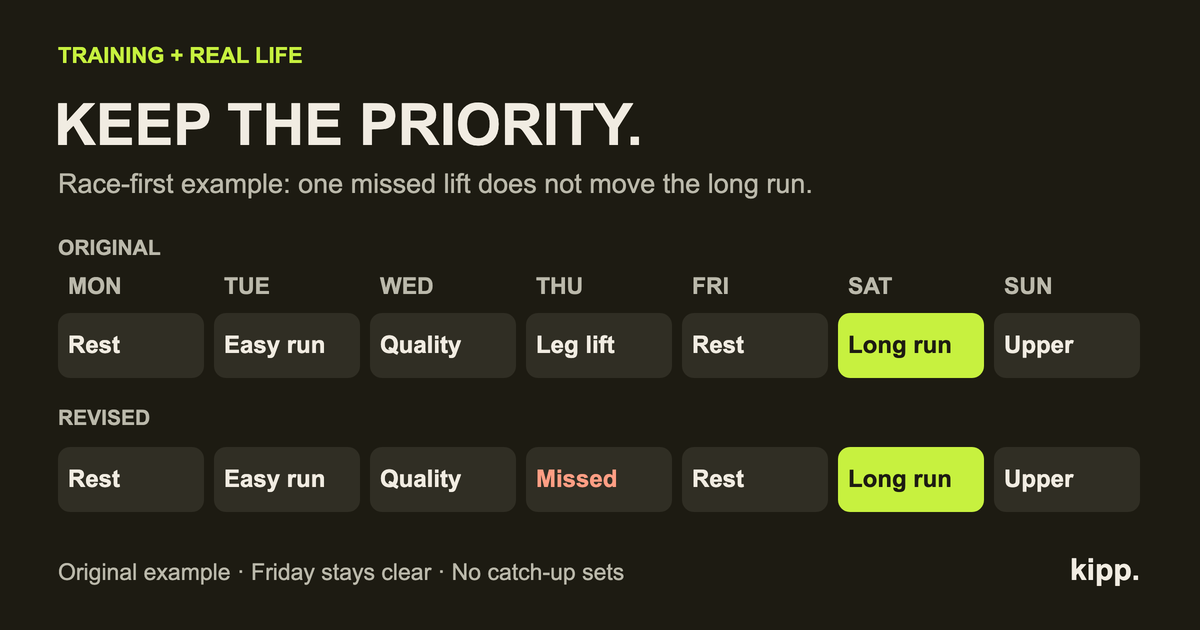
Thursday's leg session did not happen. Friday evening is free, but Saturday morning is your long run. Your watch still shows a gap where the gym session should have been.
The useful question is what the rest of this week needs to accomplish. A missed session is a reason to review the remaining calendar, not an instruction to fill every empty square.
The short answer
Choose the session that matters most for your current goal, then protect its preparation and recovery. Move the missed workout only if it fits around that priority. Otherwise shorten it, drop it, or revise the week.
This guide is for a healthy athlete who already runs and lifts and has missed a session because life got in the way. The decision tree and calendars are original coaching examples, not experimentally validated rules. An absence caused by illness or injury needs a different return decision.
First, establish what actually happened
An empty training chart does not establish that you missed training. Check the original activity on your watch or source app before changing the plan. A Strava connection can omit activities, and a chart can collapse two runs into one entry.
If you trained, correct the record. If you did not, decide why: no time, an unusually tiring week, a sore knee, or simply a session you keep avoiding. Those situations call for different changes.
A decision tree for the remaining days
Work through these questions in order. The choices below are practical defaults for this article, not a recovery clearance from a wearable score.
| Question | If yes | If no |
|---|---|---|
| Did pain, illness or unusual symptoms cause the miss? | Reassess whether to train; seek appropriate clinical advice when needed | Continue to the scheduling question |
| Is there a genuine free slot, including travel, warm-up and recovery? | Check what follows that slot | Drop or reduce the missed session |
| Would moving it compromise this week's priority session? | Protect the priority; change the missed workout's dose or omit it | A move may be workable |
| Can a shorter version still serve a clear purpose? | Keep that purpose and remove optional work | Resume the normal plan rather than forcing a token session |
Do not treat “I have an hour” as the whole answer. Friday evening to Saturday morning leaves less recovery than two separate calendar dates suggest.
A review by Doma and colleagues discusses residual fatigue from resistance exercise affecting subsequent endurance performance. It supports considering the work that comes next, but supplies no universal interval that makes your rescheduled leg day safe or productive. This is a narrative review, not a pooled trial of the calendars below.
Example one: the half marathon is the priority
Assume you already tolerate three runs and two lifts per week. Your Saturday long run is the key session during this block. You miss Thursday's lower-body lift, and Friday evening is the only additional slot.
| Day | Original week | Revised week |
|---|---|---|
| Monday | Rest | Rest |
| Tuesday | Easy run | Completed as planned |
| Wednesday | Controlled quality run | Completed as planned |
| Thursday | Lower-body lift | Missed |
| Friday | Rest | Rest |
| Saturday | Long easy run | Keep if recovered |
| Sunday | Upper-body lift | Keep if recovered |
In this example, drop the catch-up leg session. Do not add Thursday's sets to Sunday by default. The revised week contains four completed sessions instead of five, and that is an explicit adjustment.
The cost is one fewer lifting exposure this week. The benefit you are choosing is a clearer run into Saturday's priority. Neither outcome can be quantified from the table alone. For the wider arrangement, see our half-marathon plan with strength.
Example two: strength is the priority
Now assume there is no imminent race and Friday's lower-body lift matters more than Saturday's long run. The same spare slot can lead to a different decision.
| Day | Revised strength-first example | Reason |
|---|---|---|
| Friday | Familiar lower-body lift, with optional accessories removed | Preserve the main lifting exposure |
| Saturday | Rest or a short easy run if comfortable | Remove the competing long-run demand |
| Sunday | Upper-body lift if recovered | Continue without adding missed leg work |
This changes the running week as well as the lifting week. Do not quietly move the long run into Monday and create a new collision with Tuesday's training. Look across the week boundary before agreeing the change.
If you retain a short run on Saturday, use an easy effort rather than trying to recover the missed distance through pace. The example assumes you can reduce endurance volume for this block; it does not fit every race plan.
What to keep in a shortened session
Start with the purpose you want to preserve. For a familiar strength session, that might be the main lift and one supporting movement, with fewer working sets and no optional finisher. For an easy run, it might be a shorter comfortable outing with the same easy effort.
Avoid preserving the full workload by cutting out the warm-up, rushing rest periods, or running harder. That creates a different session rather than a shorter version of the intended one. There is no exact percentage reduction prescribed here because your original session and response matter.
When the same workout keeps disappearing
Repeatedly missing Thursday is evidence about Thursday. Perhaps the commute leaves too little time, the session is too long, or Wednesday's run makes it unappealing. Change the arrangement you can actually repeat.
A smaller normal week may be more useful than a larger week that requires a rescue every Friday. If combining sessions would help, our same-day running and lifting guide shows how to set the order around your goal.
When several sessions are lost through illness, do not use this catch-up framework to clear yourself for training. Persistent pain, symptoms that worsen with exercise, or an unusual drop in exercise tolerance deserve appropriate assessment. This is training guidance, not medical advice.
Sources
- Doma, Deakin and Bentley (2017): Implications of impaired endurance performance following single bouts of resistance training. Narrative review used for the narrow fatigue point, not validation of these calendars or a fixed recovery window.
- The decision tree and revised weeks are original examples; no athlete outcomes or missed-session study results are claimed.
Kipp can use your logged training, saved plan and available recovery readings when you discuss a change to the week. Tell it the new constraint, such as “Friday evening is my only free slot,” rather than reconstructing sessions already in your record. Agree the adjustment before treating it as the new plan.