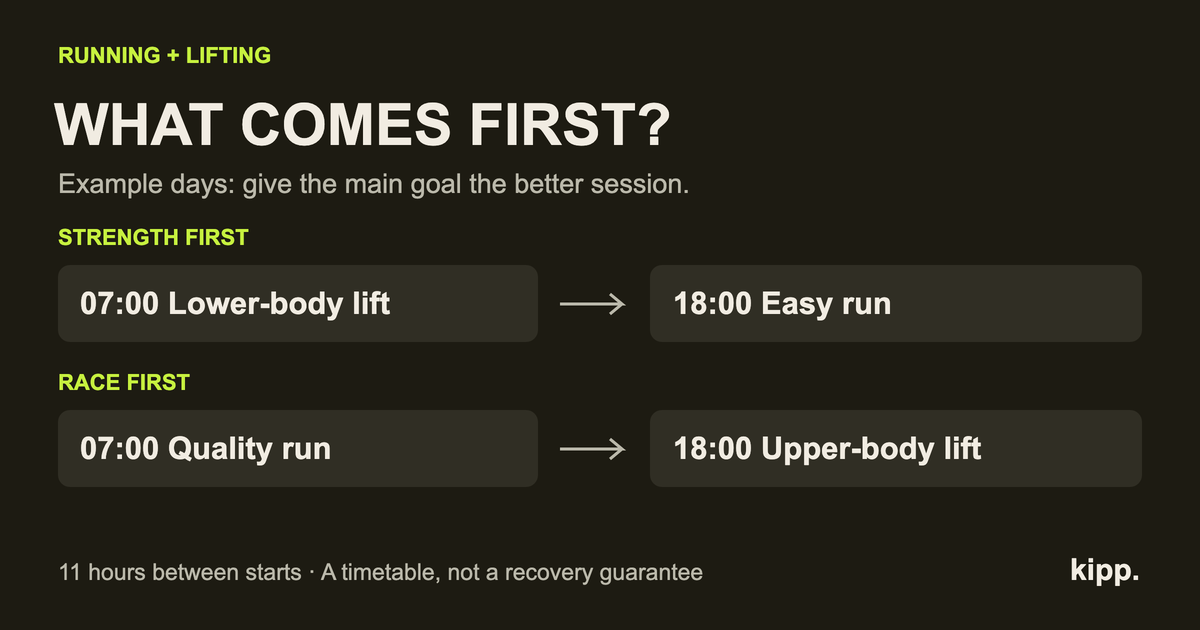
You have a run and a lift in the plan, but only one day to fit them in. “Always lift first” sounds decisive until the run is your most important session of the week.
Start with the goal of this training block. Then choose an order and a dose that give the priority session a fair chance. Combining two sessions saves a training day; it does not make either session free.
The short answer
If strength is the priority, a useful default is to lift before an easy run. If the important session is a quality run, do that first and reduce the competing gym demand. When possible, separate demanding sessions across the day or onto different days.
These are coaching defaults for healthy athletes who already tolerate both disciplines. They are not rules for returning from injury or adding a second sport from scratch. The example times below are arrangements, not scientifically established recovery intervals.
“Interference” does not mean every run costs you muscle
A 2022 meta-analysis by Schumann and colleagues included 43 studies of concurrent aerobic and strength training. The pooled results did not show reduced maximal-strength or muscle-size development compared with strength training alone, but explosive-strength gains were attenuated. The abstract reports study count rather than a participant total; none is asserted here.
The explosive-strength effect was more apparent within the same session than when sessions were separated by at least three hours. That subgroup comparison does not establish a three-hour switch after which everyone is recovered, or prove the best order for your next run. The practical schedules below are our interpretation, not protocols validated by that review.
If progress has stalled across weeks, also check total workload and food rather than blaming one paired day. Our article on squat stalls when running is added examines that broader question.
Three ways to arrange the day
| This block's priority | First session | Later session | What to avoid |
|---|---|---|---|
| Strength | Familiar lower-body lifting while fresh | A short easy run, if you recover well | Turning the easy run into intervals |
| Running performance | The important quality or long run | Upper-body lifting, or reduced gym work | A full hard leg session added out of obligation |
| HYROX preparation | The planned race-specific combination, when that is today's purpose | Only the additional work that still fits the plan | Treating a hard simulation as an easy run plus spare lifting capacity |
For HYROX, practising transitions under fatigue can be the point of a session. That is different from discovering halfway through a heavy squat workout that you still have hard intervals to complete. Keep the combined workout intentional and matched to the phase of preparation. You do not need every run to be compromised running.
Example: strength first, with an easy run later
Assume you already lift twice and run several times each week. Today is your main lower-body session, and the run has no pace target to defend.
| Time | Plan | Check |
|---|---|---|
| 07:00 | Familiar lower-body lift, including its normal warm-up | Record exercises, sets, reps and loads |
| Daytime | Meals, fluids and normal recovery | Do not leave all the day's food until dinner |
| 18:00 | 25-minute easy run, including an easy start | Shorten or omit it if your movement or effort is unusual |
The eleven-hour gap fits this fictional athlete's day. It is not a promise that soreness or fatigue will have cleared. The 25 minutes are an illustrative dose, not a minimum effective run or a requirement.
Example: the run matters most
During a race-focused block, put the quality run in the slot where you normally perform it well. If it is a morning session, an evening upper-body lift may be easier to accommodate than a demanding lower-body workout.
| Time | Plan | Check |
|---|---|---|
| 07:00 | Planned quality run, with warm-up and cool-down | Keep the intended effort rather than adding repetitions |
| Daytime | Eat and recover between sessions | Review how the run actually went |
| 18:00 | Familiar upper-body lift, reduced if needed | Leave room for the next day's training |
If both the run and the lower-body lift must be high quality, first consider different days. Changing order cannot remove the total workload. For a complete race-focused week, see our half-marathon and strength example.
Only one slot? Choose one main job
If you have one continuous session, decide which part you are protecting before you start. A strength-first example is a familiar lift followed by a brief easy run. A running-first example is the planned run followed by a short, familiar upper-body session.
Budget warm-up and transition time. Do not squeeze two full sessions into the time originally allocated to one by rushing every rest or removing preparation. If the slot still does not fit, remove optional work or choose one session.
What to compare next time
Look at the first session's quality, the second session's effort, and how you feel during the next planned workout. For strength, a watch's duration and calorie total cannot replace the sets and loads needed to judge progress. We explain that distinction in a strength workout is not a lift log.
A sequence that works on paper but repeatedly spoils the following day's session needs changing. Try reducing the second session before repeatedly testing a different clock time. If food is the missing piece, use our between-session fueling example.
Sources
- Schumann et al. (2022): Compatibility of concurrent aerobic and strength training for skeletal muscle size and function. Meta-analysis of 43 studies; the abstract supports the distinction between maximal and explosive strength and the session-separation comparison.
- The timetables and goal-based ordering decisions are original coaching examples, not measured athlete outcomes.
Kipp can discuss the order using your saved plan, logged sessions and available recovery data. Tell it which goal takes priority and when you can train; it can use the training already in your record rather than asking you to rebuild the week from memory.