Your HYROX race is two weeks away, and a shorter workout feels suspiciously like doing too little. The temptation is to squeeze in a final full simulation, one last heavy leg day, or extra running to prove you are ready.
A taper gives the work you have already done room to show up on race day. You can retain familiar touches of pace and technique while reducing the amount of training you need to recover from.
The short answer
Reduce training volume, keep brief familiar race-relevant work, and stop using workouts as last-minute fitness tests. Cut running, lifting and station demands deliberately rather than reducing only the easiest part of the week.
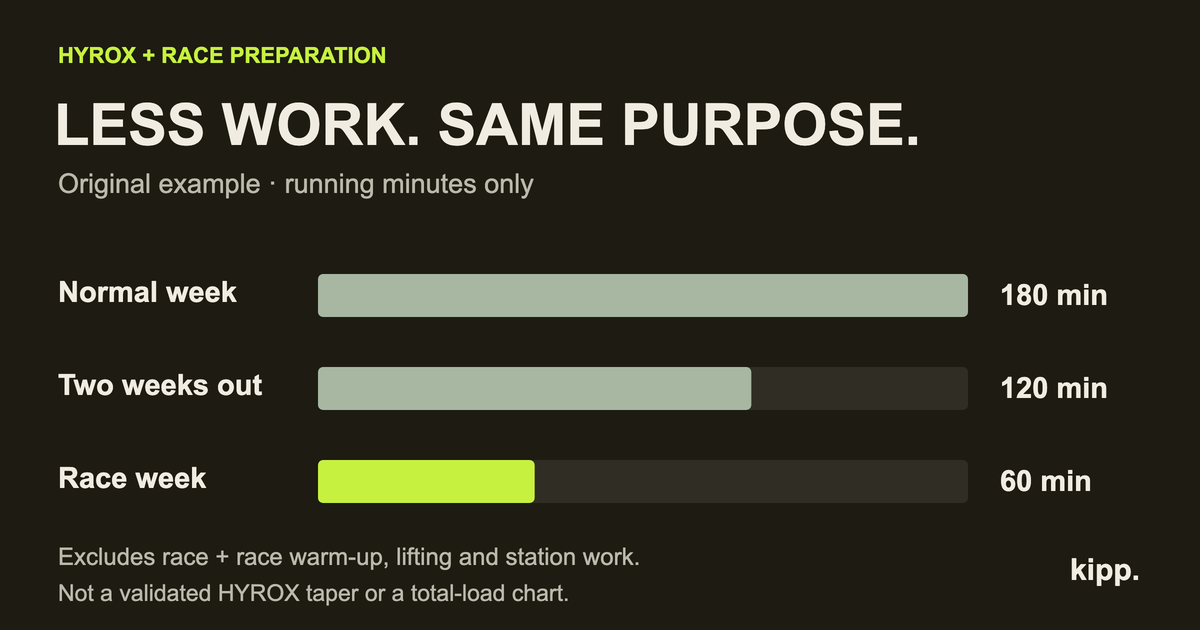
The calendar below is an original example for a healthy athlete who has already completed a consistent HYROX preparation block. It assumes a Sunday race and an ordinary running week of about 180 minutes. It is not a beginner plan, an injury workaround, or a way to make up for missed preparation.
What the research supports, and what it does not
A 2023 meta-analysis by Wang and colleagues included 14 studies and 174 endurance athletes, mainly runners and cyclists. It found improved time-trial performance with tapering; subgroup findings favoured reduced volume with intensity and frequency maintained. The paper discusses volume reductions of 41-60% and tapers up to 21 days.
Those findings do not validate a HYROX taper or a particular sled, lunge or wall-ball prescription. The table below applies a general taper principle to an illustrative hybrid week. It reduces running by one third in the first week and two thirds in race week relative to the 180-minute reference, while separately reducing gym and station work. It does not replicate the review's exact volume bands or preserve every training exposure.
Week one: leave the last demanding work behind
Running minutes include the warm-up, easy recoveries and cool-down inside each listed run. Station blocks below contain no additional running. Walking, gym warm-ups and station minutes are not hidden inside the running total.
| Day / countdown | Running | Other work or run detail |
|---|---|---|
| Monday / 13 days | 0 min | Rest |
| Tuesday / 12 days | 35 min | Include 3 × 3 min controlled, race-relevant effort; 2 min easy between |
| Wednesday / 11 days | 0 min | Reduced familiar lift; no hard finisher |
| Thursday / 10 days | 25 min | Easy run only |
| Friday / 9 days | 0 min | 15 min station technique, including easy breaks |
| Saturday / 8 days | 40 min | Easy run only |
| Sunday / 7 days | 20 min | Easy run, or omit if recovery calls for it |
| Total | 120 min | Plus one reduced lift and 15 min station practice |
For the reduced lift, use familiar exercises and fewer working sets than normal. As one example, keep two main movements for two controlled working sets each, with no grinding repetitions or optional leg finisher. That dose is a coaching example, not a strength-maintenance guarantee. If it causes disproportionate soreness, reduce it further or omit it.
Race week: keep contact with the movements
| Day / countdown | Pre-race running | Other work or run detail |
|---|---|---|
| Monday / 6 days | 0 min | Rest |
| Tuesday / 5 days | 25 min | Include 3 × 1 min controlled, race-relevant effort; 2 min easy between |
| Wednesday / 4 days | 0 min | 10 min familiar station technique, including easy breaks |
| Thursday / 3 days | 20 min | Easy run only |
| Friday / 2 days | 0 min | Rest; prepare kit and travel |
| Saturday / 1 day | 15 min | Very easy familiar shakeout, or omit if that suits you better |
| Sunday / race | 0 min | Race; its running and warm-up are excluded from the training total |
| Pre-race total | 60 min | Plus 10 min station practice; no demanding lifting |
The ten-minute station block is deliberately short and technique-led. Choose familiar movements and loads you can control without creating a hard conditioning session. It is not ten minutes of maximal work and does not need to include every station. If lunges or wall balls reliably leave you sore, reduce or omit them rather than completing a checklist.
The table's 60 minutes are pre-race training only. Race-day warm-up and the race are excluded because their durations vary. Adding the race to the final week's total and calling that “taper volume” would obscure the training reduction.
What to keep and what to remove
| Keep, if already familiar | Remove from this example |
|---|---|
| Brief controlled touches of race-relevant effort | A full simulation to test readiness |
| Short technique practice with comfortable execution | New exercises, new shoes or unfamiliar loads |
| Your usual meal rhythm and rehearsed race foods | A last-minute calorie cut because training is shorter |
| Time for sleep, travel and race logistics | Catch-up sessions from earlier weeks |
“Keep intensity” does not mean keep every hard repetition. In this example, the faster sections get shorter while the surrounding session stays controlled. You should finish without needing several days to recover from a confidence test.
If your normal week looks different
Do not copy 120 and 60 minutes if your usual week contains only 90 minutes of running. Start with your own recent, repeatable training and make a reduction from there. Keep running, lifting and station work visible as separate categories. Minutes of running do not measure total hybrid load.
For a Saturday race, shift the countdown one day earlier and remove the spare final day; do not add a workout to fill it. For doubles, relays or a different workload, adjust the station preparation to your role rather than treating this as a universal programme.
What if you feel flat?
Use how a familiar easy warm-up feels as information, alongside sleep, soreness and the training you actually completed. Avoid adding an extra hard session just because the reduced week feels unfamiliar. If you need to change something, make a small, deliberate adjustment and assess the response.
A recovery score is not a separate vote on your entire plan. Check that the reading is current before treating it as the explanation for how you feel. Pain, illness or an unusual deterioration should prompt appropriate assessment rather than reassurance from a taper calendar. This is coaching guidance, not medical advice.
Sources
- Wang et al. (2023): Effects of tapering on performance in endurance athletes. Meta-analysis of 14 studies and 174 athletes; endurance evidence, not validation of this HYROX calendar.
- Both weeks, gym doses and station durations are original examples; no race-time improvement is promised.
Kipp can use your recorded training, available recovery readings and the race date you have shared when discussing the final weeks. If travel changes the plan, tell it the new constraint and agree the adjustment. The purpose is to adapt your actual preparation rather than force a generic countdown onto it.