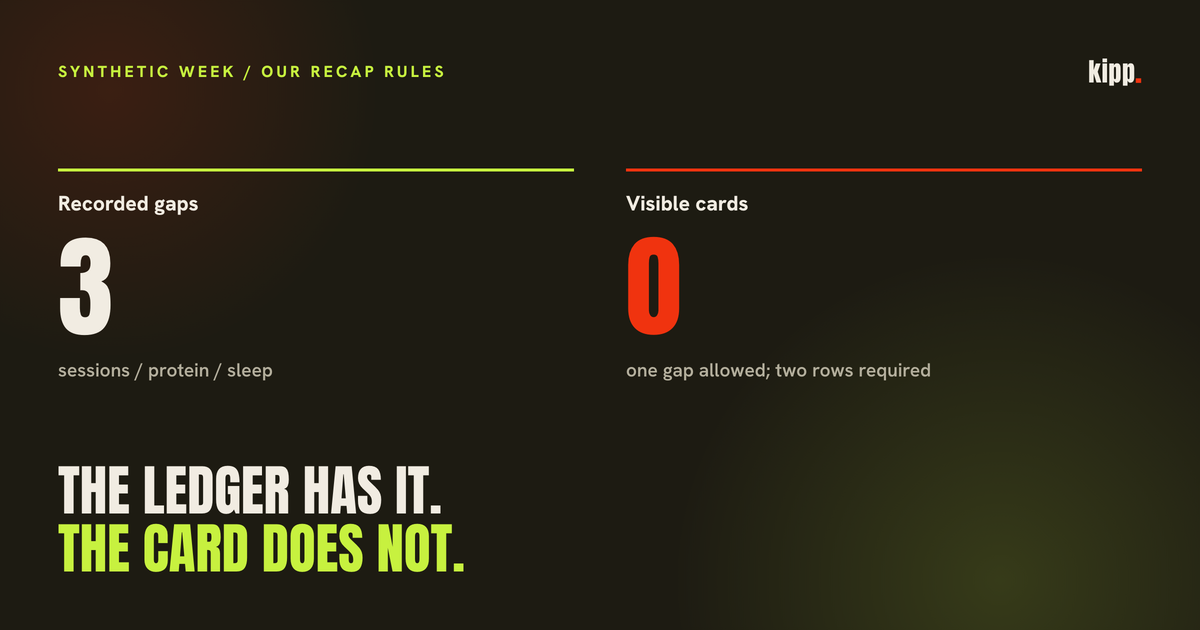
A week with one session against a target of four, 80 g against a 120 g protein target, and sleep falling from eight hours to six produces three gaps in our recap ledger. It produces no card on screen.
Those are synthetic inputs, not an athlete's private week. We executed them against our recap calculation while preparing this article. The numbers survive the calculation; the display policy removes the card. That distinction is useful whenever a wearable dashboard makes a difficult week look strangely quiet.
The short answer
A weekly recap is a selection from your records. In our implementation, missing observations are dropped before grading, then the visible card is capped at two wins and one gap. A blank row can mean missing evidence or an editorial choice. Neither means you met the target. Read the underlying week before treating the card as a complete assessment.
Two filters sit between your watch and the card
The first filter asks whether there is a number the app can report. Our recap removes a session count of zero when it has established that your sessions cannot be observed. A protein row needs both an average and a target. A sleep row needs a numeric average supplied by the data reader. These are requirements of our implementation, not universal rules for fitness apps.
The second filter chooses which reportable numbers fit on screen. The app first collects the available measurements. The visible card selects at most two wins, one gap and any remaining holds, then caps the whole card at four rows. Fewer than two selected rows means the card disappears.
That creates two different kinds of silence. One says the app lacks enough evidence to make the row. The other says it has evidence but chose a smaller presentation. You cannot distinguish them by counting the rows that remain.
The week we put through it
Our worked example includes a previous week, so this is not first-week baseline mode. The output ledger is:
| Metric | Input | Ledger verdict |
|---|---|---|
| Sessions | 1 against a target of 4 | Gap, short by 3 |
| Protein | 80 g against a target of 120 g | Gap, short by 40 g |
| Sleep | 8 h previously, 6 h now | Gap, down 2 h |
The one-gap cap keeps Sessions and drops the other two from the card selection. One row is below the two-row minimum, so no card is shown. This is one constructed case demonstrating a display rule, not a measurement of how frequently real athletes encounter it.
The rationale is that a week with several setbacks deserves a conversation rather than a scoreboard. That is a product judgment. It does not make the discarded rows untrue, and it makes the surrounding words responsible for explaining a week the card no longer shows.
The coaching text gets a different view
The coaching text receives the full set of measurements before the card is shortened. In this example it receives all three gaps and a note that no card is on screen. It asks the coach to discuss the week in words and raise at most one thing to work on.
That separation matters: a presentation cap should not become a blind spot in the inputs used to write advice. The inference is straightforward, but limited. Having the full ledger available does not prove that a generated response will explain every relevant fact. This example verifies the supplied data and card selection, not the quality of every coaching reply.
There is another asymmetry in the implementation: steps rising by at least 500 can earn a win, while a decline is a hold. Endurance distance is context, always a hold. Those labels are policy choices about what deserves attention; they are not a common scale that can be added up into an overall fitness score.
Zero sessions needs its own question
To check whether sessions can be seen, the app looks back 120 days for imported activity or logged exercise content. This is evidence that a pipeline has worked, not a guarantee that it worked this week. Its connector probe accepts any activity row, and a read error falls back to assuming observability.
Those limits are why the claim must stay narrow: an explicitly unobservable zero is hidden. We cannot claim that every displayed zero proves inactivity. A stopped sync or a discipline that arrives as Other still needs investigation. The Apple Health workout-type article explains how much can disappear between a typed workout and a coaching summary.
What to compare before accepting the recap
Open the workout list for the exact dates in the recap. Compare session targets with actual sessions, and check whether averages state how many days supplied data. A first week also needs a different reading: our baseline mode removes improvement and decline verdicts because there is no previous week to compare.
If a metric is absent, ask whether it lacked observations or was left off the card. If the card is absent, ask for the recorded week in words. Those questions test what the summary represents without treating a friendly tone as a measurement.
Kipp keeps the uncapped weekly ledger available to its coach even when the visible recap is shortened or absent. That separation lets the conversation use the recorded week without pretending the card shows everything.